
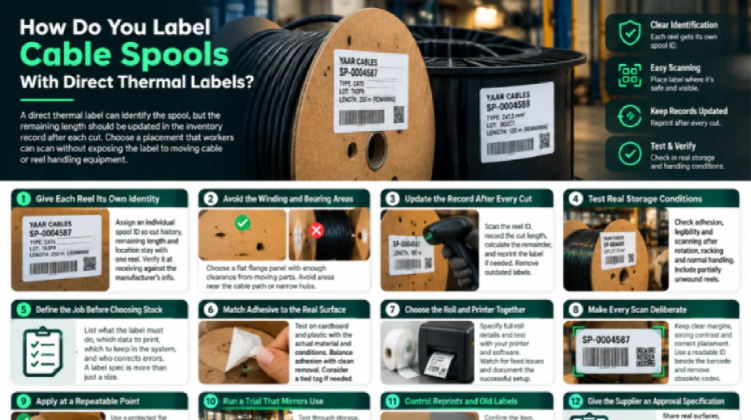
Cable inventory changes as material is cut from a reel. A direct thermal label can identify the spool, but the remaining length should be updated in the inventory record after each cut. Choose a placement that workers can scan without exposing the label to moving cable or reel handling equipment.
Give Each Reel Its Own Identity
The cable specification and lot may be shared by many reels. Assign an individual spool ID so cut history, measured remaining length, and location stay attached to one physical reel. Print that ID clearly, then verify it at receiving against the manufacturer’s reel information. Do not rely on a handwritten length on a label that becomes outdated after the next cut.
Avoid the Winding and Bearing Areas
A label near the cable path can abrade, while a label wrapped around a narrow hub can wrinkle. Choose a flat flange panel with enough clearance from a forklift tine or rack contact point. On a small reel without safe flat space, use a tied tag secured according to the operation’s handling rules.
Update the Record After Every Cut
Scan the reel ID before cutting, record the cut length, and calculate or measure the remainder using the approved method. If the remaining length must appear on the physical label, reprint it from the current system record and remove the outdated version. Two visible lengths on the same reel invite a pick error.
Test Real Storage Conditions
Apply sample labels to dusty cardboard and plastic flanges, then rotate, rack, and move loaded reels as usual. Check legibility after rubbing and after the longest storage interval. Include a reel that has been partly unwound, because its handling pattern may differ. Record whether failures are caused by placement, surface condition, or imaging life.
Define the Job Before Choosing Stock
Write down exactly what the label on cable spools must accomplish during warehouse storage, cutting, and dispatch. Decide which field a worker reads, which code a scanner captures, and when the information can be retired. The working data may include cable type, lot, spool ID, and remaining length; distinguish fields that must be printed from those better kept in the inventory system. Decide who owns an incorrect record and how it is corrected. A label specification based only on dimensions misses the process that gives the printed mark its meaning.
Match Adhesive to the Real Surface
Test the proposed adhesive on cardboard reel flanges and plastic spool hubs, using the exact material supplied to production. Apply it at the normal work area temperature and inspect it after the planned dwell, not only after a few minutes. The main challenges here are curved hubs, abrasion, dusty flanges, and changing remaining length. A stronger adhesive may hold better but can create residue or damage during removal. If direct application is unreliable or undesirable, assess a tied reel tag or fixed flange plate. Keep approved samples from each packaging or carrier supplier so a later material substitution triggers a targeted retest.
For this application, compare cable spool labels on the actual cardboard reel flanges and plastic spool hubs and through the planned handling interval. Ask for samples before choosing a full production roll.
Choose the Roll and Printer Together
Specify the roll as a complete print system for cable spools: face size, gap, liner width, core, outside diameter, winding, sensor feature, and approved printer model. Test a converted roll with the real application software and production speed. Watch for a skipped label after reloading and for print moving toward a die-cut edge. Document the successful calibration and template version. A cheap roll is expensive if operators must keep adjusting it to finish a shift.
Make Every Scan Deliberate
Design the barcode for the scanner and distance used with cable spools. Leave the required clear margin, preserve contrast, and keep the code away from folds, seams, edges, or moving parts. Put the most useful human-readable identifier beside it so staff can spot a mismatch. If more than one code appears on the object, state which workflow uses each one and remove obsolete routing codes. Print the longest data value and smallest label in the test set; a short sample code can hide layout problems.
Apply the Label at a Repeatable Point
The preferred position is a protected flat flange panel away from the winding path. Apply only after the object or package has reached the form it will have during normal handling. Remove loose dust or moisture where the process permits, press across the entire label, and check the corners. Give workers a simple placement guide showing the approved zone and the areas to avoid. If the application surface changes between suppliers or batches, check a few finished units before the shift continues. An attractive label applied in the wrong place is still a failed label.
Run a Trial That Mirrors Use
Print a production roll and test it on the hardest version of cable spools, then follow it through warehouse storage, cutting, and dispatch. Check printer feed, initial readability, adhesion, edge lift, and scanning at each real handoff. Include the worst expected combination of curved hubs, abrasion, dusty flanges, and changing remaining length. Keep both successful and failed examples with the time and conditions recorded. If a sample fails, change one factor at a time, such as placement, adhesive, size, or print settings. This makes the result useful for purchasing rather than a vague pass or fail.
Control Reprints and Old Labels
A replacement label for cable spools should never be issued solely because an operator can see a plausible old number. Confirm the item or carrier using the approved secondary evidence, retrieve its current record, and reprint the authorized code. Retire conflicting old labels and check the new print at the next scan point. Track reprints separately from first-pass output so purchasing can see whether the construction, printer, or handling workflow is causing avoidable waste.
Give the Supplier an Approval Specification
Send a sample of cardboard reel flanges and plastic spool hubs, the printer model, a dimensioned label drawing, roll geometry, required data and barcode layout, expected life, and the environmental conditions described above. Ask for converted-roll samples of the proposed construction. Agree on the acceptance test before a bulk order, including feed performance, scan success, bond after normal handling, and removal behavior when relevant. Record the approved material, adhesive, liner, die cut, and winding as one controlled specification. Compare cost per successfully labeled unit rather than only the blank-label price.
When evaluating thermal barcode labels for cable spools, give the supplier the real surface, printer details, and pass criteria rather than a size alone.